
On July 2, 2026, the Pennsylvania Department of Environmental Protection (DEP) announced proposed updates to its biosolids beneficial use general permits, introducing PFAS monitoring and land application limits in draft permits PAG-07 (Beneficial Use of Exceptional Quality Biosolids) and PAG-08 (Beneficial Use of Biosolids). The two draft permits are available at the links at the end of this article and are subject to the same 60-day public comment period, which closes September 2, 2026.
Monitoring Requirements
For both PAG-07 and PAG-08, monitoring for PFOA and PFOS shall, at a minimum, occur pursuant to the following frequency:
| Amount of biosolids Dry tons (dry metric tons) per 365-day period | Frequency (per 365-day period) |
| Greater than zero but less than 319 (290) | Twice per year |
| Equal to or greater than 319 (290) | Once per quarter (four times per year) |
The “Amount of biosolids” is either the amount of biosolids land applied or the amount of biosolids generated to be land applied for beneficial use or the amount of biosolids received by a person who prepares biosolids for land application.
PFAS shall be analyzed using EPA method 1633.
The New Tiered PFAS Framework
DEP has proposed a four-tier system based on PFOS and PFOA concentrations in biosolids, which applies to both PAG-07 and PAG-08:
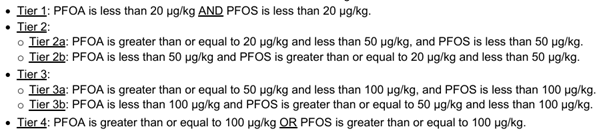
For reference, ug/kg is the equivalent to parts per billion (ppb).
Notification to the landowner of the tier classification of the biosolids that are being land applied is required on an annual basis, and any changes in the qualification following the annual notification must also be provided.
Land applications of biosolids that qualify as Tier 1 are unrestricted other than the required landowner notification, and do not require a source reduction plan.
The land application of biosolids that qualify as Tier 2 or Tier 3 require reduced maximum application rates (3.0 and 1.5 dry tons/acre, respectively), require a source reduction plan, and landowner notification of the Tier classification. The land application of biosolids that qualify as Tier 4 is prohibited, though a source reduction plan is required to demonstrate a reduction of PFOS and PFOA below the Tier 4 limits, following which land application of such materials can resume.
Source Reduction Plan Components
For a permittee with Tier 2, Tier 3, or Tier 4 biosolids, DEP expects source reduction plans to address:
- Identifying all industrial, commercial, institutional, and residential contributors to the wastewater stream.
- Development and implementation of a plan to reduce and eliminate the identified sources of PFAS contributing to the wastewater.
- Monitoring and reporting of PFAS samples for biosolids to determine the efficacy of the source reduction plan.
Per DEP, a source reduction Plan must be submitted within 90 days of a permittee’s receipt of sampling results that qualify the biosolids as Tiers 2, 3 or 4, and must include a sample and analysis plan that is consistent with the DEP’s Biosolids Sampling Manual.
Land application of Tier 2 and Tier 3 biosolids is prohibited until DEP approval of the source reduction plan. For Tier 4 biosolids, if a source reduction plan does not reduce PFOA and PFOS below Tier 4 limits, then land application of that biosolids is prohibited.
How to Submit Comments
DEP is accepting public comments on the two draft permits for 60 days. The comment period closes on September 2, 2026. Comments may be submitted through:
- DEP’s eComment platform: www.ahs.dep.pa.gov/eComment/
- Email: ecomment@pa.gov (emailed comments must include the originator’s name and address)
The draft permit documents are available at the following links: